
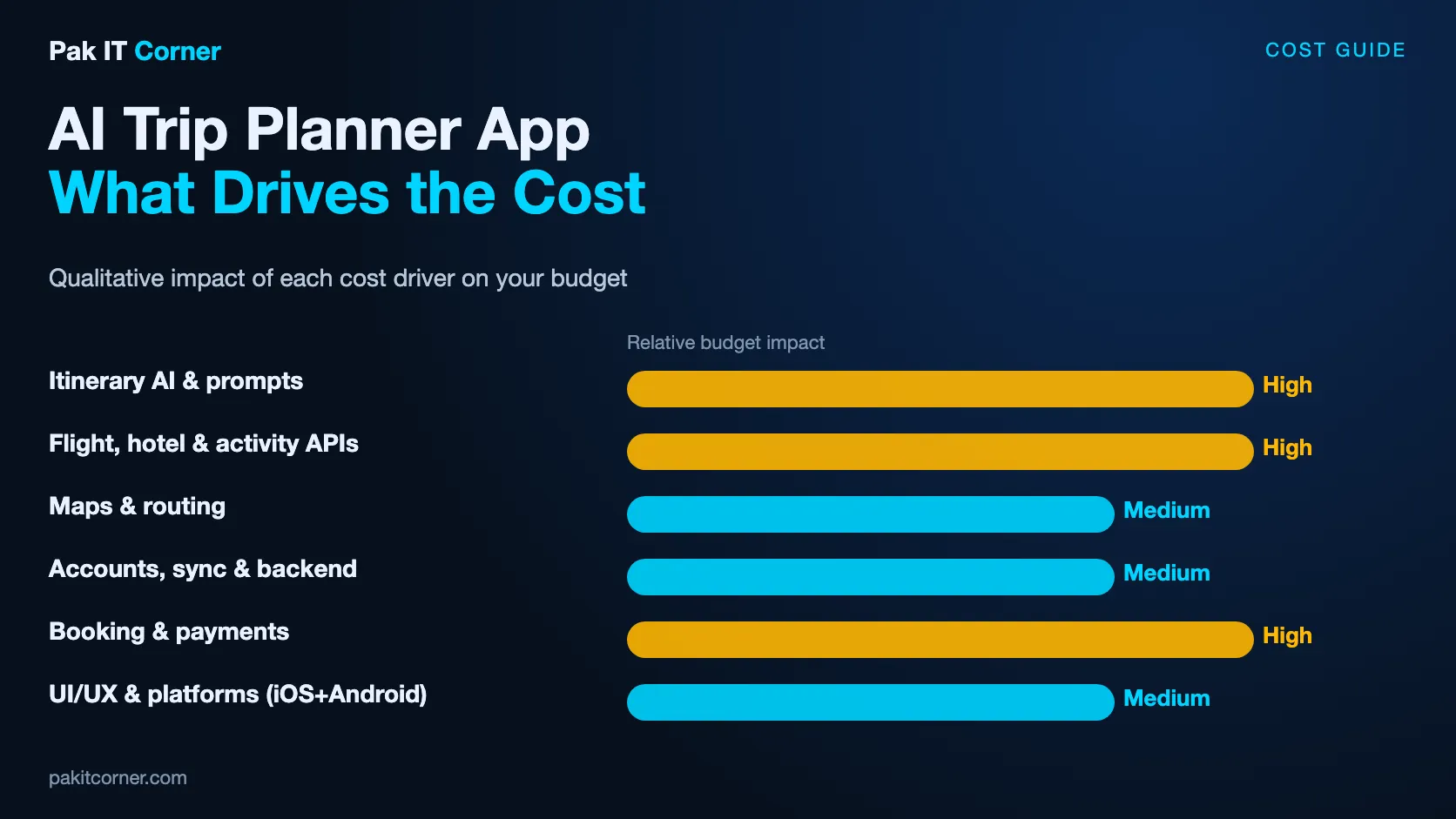
"How much does it cost to build an AI trip planner app?" is the first question most founders ask, and the honest answer is that it depends on scope far more than on the label "AI". A simple planner that generates and saves itineraries is a very different project from a platform that searches flights, books hotels and takes payments. This guide explains the cost drivers so you can estimate your own project, scope it sensibly and avoid surprises. We do not quote a single headline price here, because a number without a scope is misleading; instead we show what pushes the budget up or down.
If you want the technical blueprint first, read our guide to building an AI travel planning app. This article focuses on the money.
Start with scope: three typical tiers
- Itinerary generator: users enter a destination, dates and interests and the AI produces a day-by-day plan they can save, edit and share. Lowest cost of the three.
- Planner with live data: adds real flight, hotel and activity information, maps and travel times, and reservations tracking. A mid-range project with significant integration work.
- Planner with booking and payments: users book and pay inside the app. The highest cost and complexity, because of supplier integrations, payments and customer support.
Decide which tier you are building before asking for estimates. Most of the cost difference between quotes comes from tiers, not from hourly rates.
The AI layer
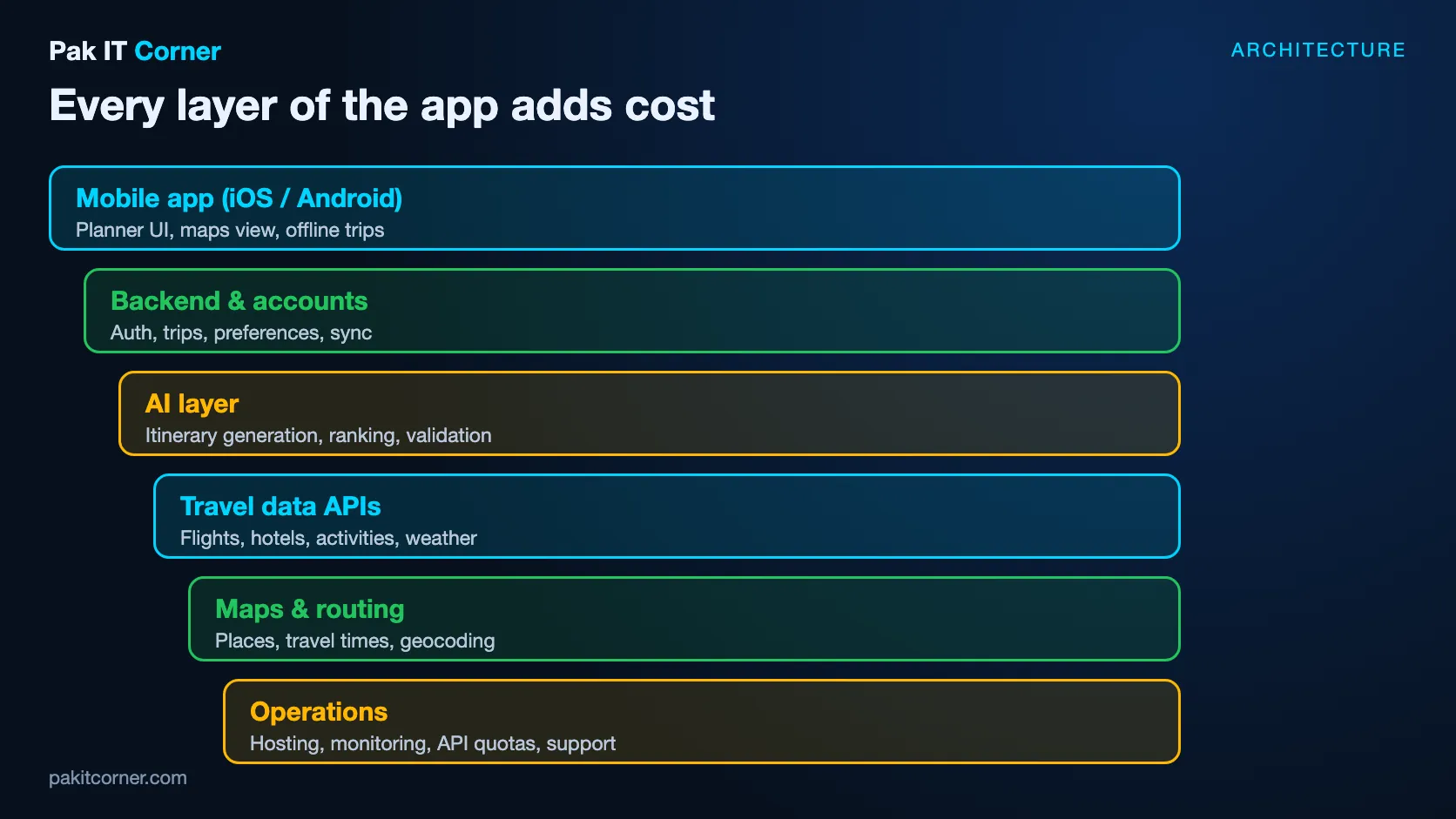
The AI itself is rarely the largest line item, but it needs more than a single prompt. Costs come from designing prompts and output formats, validating the results (so the AI does not invent places, opening hours or impossible routes), grounding responses in real data, handling errors and building a feedback loop. There is also a running cost: most AI model providers charge per usage, so cost grows with the number of itineraries your users generate. Caching common results and limiting regeneration can control it.
Travel data and APIs
Real flights, hotels and activities come from data providers and aggregators. Access models vary: some offer open APIs with usage-based pricing, others require partner agreements, approval and commission or affiliate arrangements. Integration time depends on the quality of the provider's documentation, rate limits, data formats and how many providers you combine. Budget for integration, testing across edge cases and monitoring when providers change their APIs.
Maps, places and routing
Showing places on a map, calculating travel times and suggesting efficient routes use mapping and places APIs, which usually bill per request. Heavy map usage can become a meaningful recurring cost at scale, so design the app to minimise unnecessary calls and cache results where the terms allow it.
Backend, accounts and sync
Even a simple planner needs a backend: user accounts, saved trips, preferences, sharing, sync between devices and an admin tool to manage content and support. This is predictable work, and cloud services make it faster, but it is a real part of the budget. Offline access to saved trips is a popular feature for travellers and adds engineering effort.
Booking and payments
This is usually the biggest cost multiplier. Booking inside the app means integrating supplier booking APIs, handling availability and price changes, processing payments securely, managing cancellations and refunds, and providing customer support. Payment handling also brings security and compliance work. If budget is tight, a common approach is to link out to booking partners or use affiliate links at first, and add in-app booking later once the product is proven.
Platforms, design and testing
- One codebase or two: building iOS and Android natively costs more than a cross-platform approach such as Flutter. Our Flutter vs native comparison explains the trade-offs, and iOS vs Android: which first helps you phase the launch.
- Design: a travel app lives or dies on its experience. Good UX research, interface design and a polished map and itinerary view are worth budgeting properly.
- Testing: AI output, live data and payments all need careful testing across devices, locations and edge cases.
- Privacy and compliance: location data and personal information need clear consent and compliance with rules such as GDPR where relevant.
Ongoing costs after launch
The build is not the whole cost. Plan for:
- AI usage charges that grow with active users.
- Travel data and maps API fees.
- Cloud hosting, storage and monitoring.
- App store developer fees and platform commissions on in-app purchases.
- Maintenance: OS updates, bug fixes, API changes and security patches.
- Customer support, especially if you handle bookings.
Many teams budget an ongoing amount each year for maintenance and improvements on top of variable usage costs, so ask any development partner what they recommend for your scope.
How to keep the budget under control
- Launch the itinerary generator first. Prove that users value the AI plans before building booking.
- Use affiliate or deep links for flights and hotels instead of in-app booking at the start.
- Go cross-platform to cover iOS and Android from one codebase.
- Control AI usage with caching, sensible limits and efficient prompts.
- Define a clear MVP and move other features into later phases.
How to estimate your own project
List the features in your first release, assign each to the AI layer, data APIs, maps, backend, booking or design, and mark which ones involve third parties. Then ask for estimates by tier or by feature, not as one lump sum, so you can see where the money goes and what you could defer. For general pricing context, our mobile app development cost guide covers complexity tiers, and our packages page shows starting prices.
Frequently asked questions
How much does it cost to build an AI trip planner app?
There is no single price because cost depends on scope. An itinerary generator is the cheapest tier, a planner with live flight, hotel and map data costs more, and a platform with in-app booking and payments is the most expensive. The best way to get a reliable figure is to scope your first release feature by feature.
What is the biggest cost driver in a trip planner app?
In-app booking and payments is usually the largest multiplier because of supplier integrations, payment security, cancellations and customer support. The AI layer and travel data integrations are the next biggest drivers.
Are there ongoing costs after the app launches?
Yes. Expect AI usage fees, travel data and maps API fees, cloud hosting, app store fees and commissions, maintenance for OS updates and API changes, and support if you handle bookings.
Can I reduce the cost of an AI trip planner app?
Yes. Launch an itinerary generator first, use affiliate or deep links instead of in-app booking, build cross-platform with Flutter, control AI usage with caching and limits, and keep your MVP small.
Do I need separate iOS and Android apps?
Not necessarily. A cross-platform framework such as Flutter lets one codebase serve both, which usually reduces cost and time. Native apps make sense when you need the best performance or deep platform features.
Get a scoped estimate for your trip planner app
At Pak IT Corner we build AI-enabled mobile and web apps for startups. Send us your feature list and target platforms and we will help you separate must-haves from nice-to-haves and give you a clear view of scope, timeline and cost. Explore our iOS and Android development services, or learn how to choose a mobile app development company.