Choosing the right mobile app development company can have a major impact on the success of your digital product. A strong development partner does more than write code. They help transform your idea into a reliable, scalable, secure, and user-friendly application.
Whether you are building a startup MVP, business application, e-commerce platform, IoT companion app, booking system, or custom enterprise solution, selecting the right development team requires careful evaluation.
This guide explains what to look for when choosing a mobile app development company and which questions you should ask before starting your project.
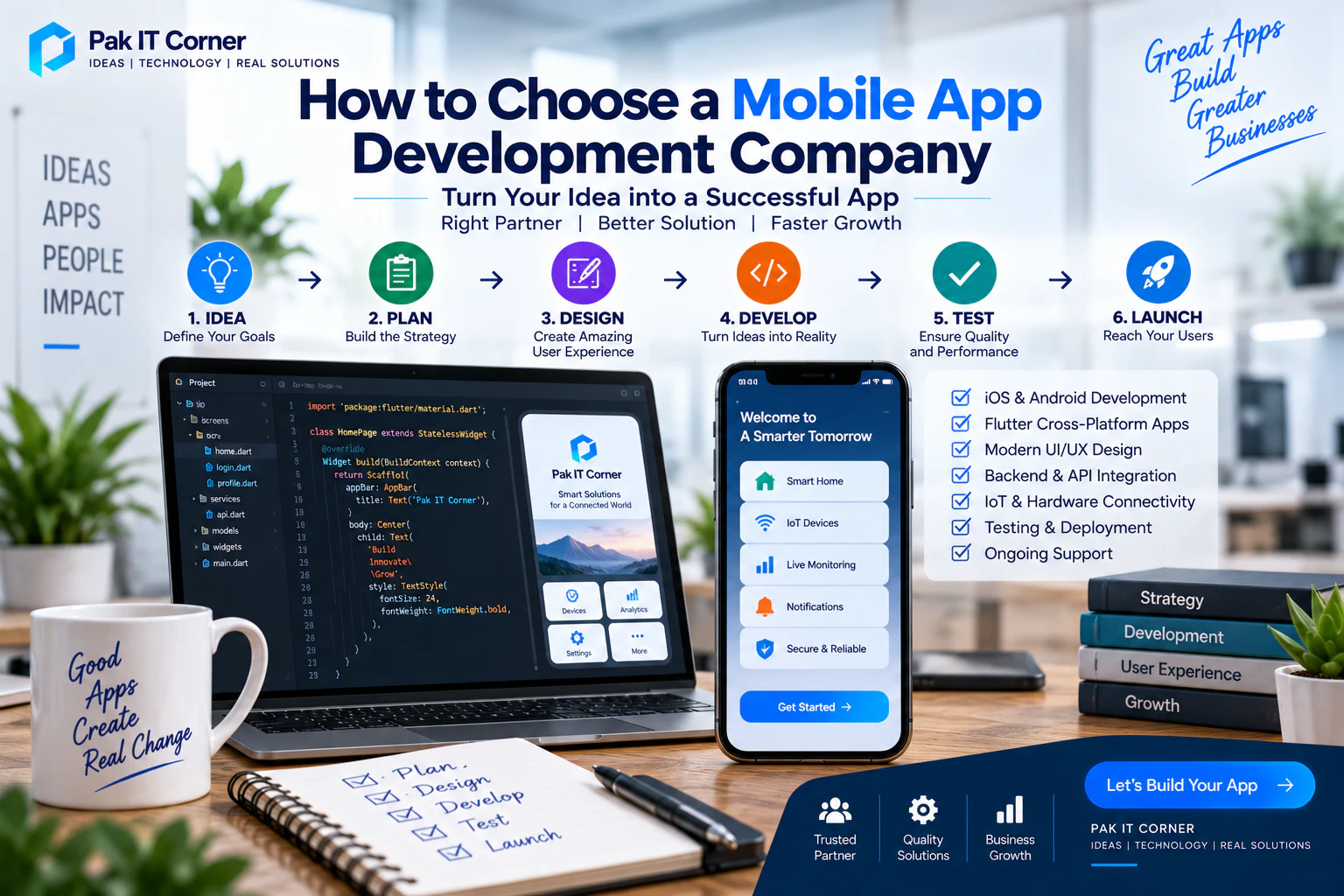
Why Choosing the Right App Development Company Matters
A mobile application is often a long-term investment rather than a one-time development task.
After the initial launch, your application may require:
- New features
- Performance improvements
- Bug fixes
- Operating system updates
- Security updates
- API changes
- Backend improvements
- App Store and Google Play updates
- Analytics and monitoring
- Ongoing technical support
Choosing a development company only because it offers the lowest price can create significantly higher costs later if the application needs to be rebuilt or extensively repaired.
The right development partner should understand both your immediate requirements and your long-term product goals.
1. Define Your Project Before Contacting Developers
Before comparing development companies, clearly define what you want to build.
You do not necessarily need a complete technical specification, but you should understand the basic purpose of your application.
Start by answering questions such as:
- What problem will the application solve?
- Who are the target users?
- Will the application be available on Android, iOS, or both? (see our iOS vs Android guide)
- What are the most important features?
- Does the application require user accounts?
- Will payments be required?
- Does it need a backend or cloud platform?
- Does it communicate with physical hardware?
- Does it require Bluetooth, Wi-Fi, GPS, NFC, cameras, or other device features?
- Do you need an administration dashboard?
- What is your approximate budget? (see our 2026 app development cost guide)
- What is your expected launch timeline?
Clear requirements make it much easier to compare proposals from different development companies.
2. Check the Company's Technical Expertise
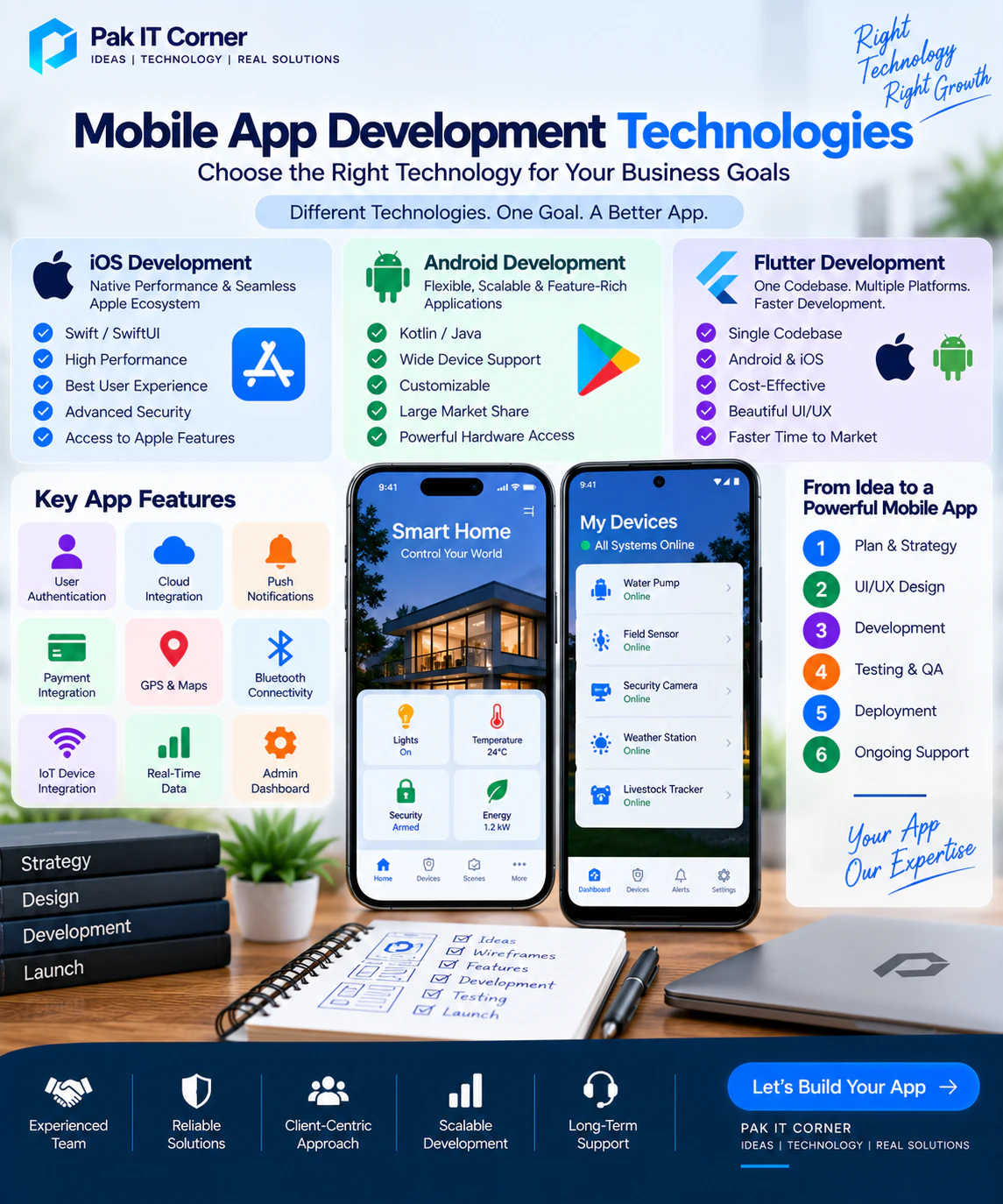
Mobile applications can be developed using several technologies.
A capable development company should understand which technology is appropriate for your project instead of recommending the same solution for every application.
Common technologies include:
Native iOS Development
Native iOS applications are commonly developed using:
- Swift
- SwiftUI
- UIKit
- Xcode
Native iOS development can provide deep integration with Apple's ecosystem, superior hardware acceleration, and excellent performance.
Native Android Development
Android applications are commonly developed using:
- Kotlin
- Java
- Jetpack Compose
- Android Studio
Native Android development provides extensive access to Android platform capabilities, background services, and hardware features.
Cross-Platform Development
Frameworks such as Flutter allow developers to create Android and iOS applications from a largely shared codebase.
Flutter development can be particularly useful when businesses want:
- Android and iOS applications simultaneously
- Faster time-to-market
- Consistent user interfaces across devices
- Shared application logic
- Lower maintenance complexity
The development company should explain why it recommends a particular technology for your project.
3. Review Real Projects and Portfolio
A portfolio provides valuable information about a company's actual experience.
Do not evaluate a portfolio based only on attractive screenshots. Look deeper into the projects.
Consider whether the company has experience developing:
- Consumer mobile applications
- Business applications
- IoT applications
- E-commerce systems
- Dashboards
- Booking applications
- Location-based applications
- Bluetooth applications
- Cloud-connected products
- Subscription platforms
- Custom APIs
A portfolio containing projects similar to yours can indicate that the team already understands some of the technical challenges your project may encounter — see examples in our portfolio.
4. Look for Relevant Industry Experience
General mobile development experience is useful, but relevant technical experience can be even more important.
For example, an IoT mobile application may require knowledge of:
- Bluetooth Low Energy (BLE)
- Wi-Fi provisioning
- MQTT protocols
- REST APIs
- Device authentication
- Firmware updates (OTA)
- Real-time sensor data streaming
- Device configuration
- Cloud platforms
- Embedded systems (ESP32 and STM32)
A team experienced only with simple content applications may struggle with these requirements.
The development partner should understand the technologies surrounding the application, not only the mobile interface.
5. Evaluate UI and UX Capabilities
Users often judge an application within seconds.
An application can have excellent backend technology but still fail if the interface is confusing or difficult to use.
Good UI/UX design should provide:
- Clear navigation
- Consistent visual design
- Readable typography
- Responsive layouts
- Simple onboarding
- Accessible controls
- Logical user flows
- Helpful feedback
- Appropriate loading states
- Clear error messages
The interface should be designed around the user's goals rather than simply displaying every available feature.
6. Understand Their Development Process
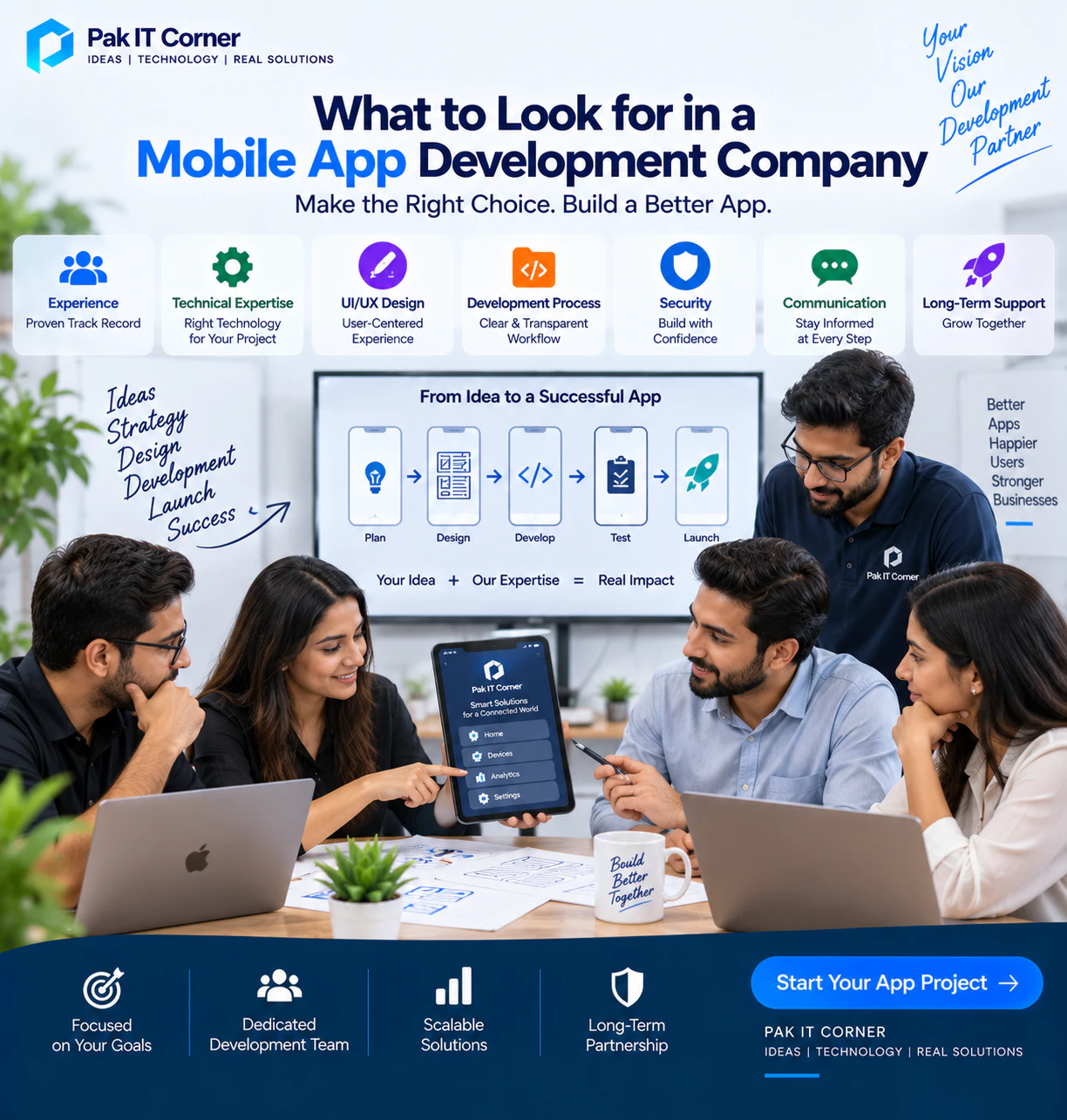
Professional development should follow a structured process.
A typical workflow may include:
- Requirements analysis
- Technical planning
- UI/UX design
- Architecture development
- Mobile application development
- Backend development
- API integration
- Testing
- Client review
- App Store and Google Play deployment
- Post-launch support
Ask the company how it handles each stage. A clear process reduces misunderstandings and makes project progress easier to evaluate.
7. Ask How Project Milestones Are Managed
Large projects should usually be divided into manageable milestones.
For example:
Milestone 1 — Planning and Architecture: Requirements, application architecture, technology selection, and project roadmap.
Milestone 2 — UI/UX: Wireframes, user flows, interface design, and design approval.
Milestone 3 — Core Development: Implementation of major application features.
Milestone 4 — Backend and Integrations: APIs, databases, authentication, payments, cloud services, or hardware communication.
Milestone 5 — Testing: Functional testing, compatibility testing, performance testing, and bug fixing.
Milestone 6 — Deployment: App Store and Google Play preparation and release.
Milestones provide visibility and allow both the client and development team to confirm progress before moving forward.
8. Ask About Communication
Communication problems can damage even technically strong projects.
Before hiring a company, understand how communication will work.
Ask:
- Who will be your main contact?
- How frequently will progress be reported?
- Will you receive demonstrations during development?
- How will changes be discussed?
- How are bugs reported?
- Which communication tools are used?
- Will technical decisions be documented?
Regular communication allows problems to be identified before they become expensive.
9. Evaluate Their Backend Development Experience
Many mobile applications depend heavily on backend infrastructure.
A backend may handle:
- User accounts
- Authentication
- Databases
- Payments
- Notifications
- File storage
- Business logic
- Device management
- Analytics
- Subscription management
- Administration dashboards
Your development company should understand how the mobile application communicates securely with these systems. Backend architecture should also be designed with future growth in mind.
10. Check API Integration Experience
Modern applications frequently connect to third-party services.
Common integrations include:
- Payment gateways (Stripe, PayPal, Apple Pay, Google Pay)
- Maps and geolocation
- Authentication providers (Google, Apple, Firebase)
- Cloud storage (AWS S3, Google Cloud)
- Analytics platforms
- CRM systems
- E-commerce systems
- Messaging services
- AI services
- IoT platforms
Ask whether the company has experience integrating external APIs and handling authentication, errors, rate limits, and changing API versions.
11. Consider Security From the Beginning
Security should not be something added after development is complete.
Depending on the application, important security measures may include:
- HTTPS transport encryption
- Secure authentication and refresh token management
- Hardware-backed credential storage (iOS Keychain, Android Keystore)
- API authorization and role-based access control
- Input validation and sanitization
- Secure database access rules
- Protection of sensitive personal and payment data
Applications handling payments, personal information, health records, location data, or connected devices may require additional security measures.
Ask the development company how security is incorporated into its architecture and development process.
12. Ask About Testing
Testing is one of the most important stages of application development.
Professional testing should cover more than checking whether buttons work.
Testing may include:
- Functional testing
- UI testing across multiple screen sizes
- Device compatibility testing
- Network interruption and offline caching handling
- Authentication flows and edge cases
- API failure recovery
- Performance and memory leak profiling
- Battery usage optimization
- Permissions handling
- Push notification delivery
- Background execution behavior
- App upgrade migration testing
For hardware-connected applications, testing should also include real physical devices.
13. Check Experience With App Store and Google Play Deployment
Building the application is only part of the process. Publishing requires knowledge of platform requirements.
For iOS, developers may need to manage:
- Apple Developer accounts
- Certificates and provisioning profiles
- App Store Connect setup
- TestFlight beta distribution
- Privacy declarations and nutrition labels
- Screenshots, preview videos, and metadata
- App review compliance
For Android, deployment may involve:
- Google Play Console
- App signing keys
- Android App Bundles (AAB)
- Internal, closed, and open testing tracks
- Data safety forms
- Store listings and graphics
- Device compatibility rules
- Google Play policy compliance
A development company with deployment experience can help prevent unnecessary delays during launch.
14. Understand Who Owns the Source Code
Source-code ownership should be discussed before development begins.
You should clearly understand who owns:
- Mobile application source code
- Backend source code
- UI/UX design files
- Database architecture
- API documentation
- Cloud configuration
- Project assets
- Deployment credentials
For custom client projects, ownership and delivery conditions should be clearly defined in the agreement.
Avoid discovering after development that important parts of your product are inaccessible.
15. Keep Important Accounts Under Your Control
Whenever practical, important production accounts should belong to the client or business.
These may include:
- Apple Developer account
- Google Play Console
- Domain registration
- Web and cloud hosting
- Cloud infrastructure (AWS, GCP, DigitalOcean)
- Analytics accounts
- Payment gateway accounts
- Firebase project
- Git repository
Developers can be granted appropriate access without permanently owning critical business infrastructure.
This makes future maintenance and team transitions much easier.
16. Ask About Documentation
Documentation becomes increasingly important as an application grows.
Useful documentation may include:
- Project architecture overview
- API documentation (Swagger / OpenAPI)
- Database schema and migrations
- Local environment setup instructions
- Deployment procedures and CI/CD pipelines
- Environment variable configuration
- Third-party integration details
- Hardware communication protocols (for IoT products)
- Credential and service account management
Good documentation reduces dependency on individual developers and protects your company's intellectual property.
17. Understand the Pricing Model
App development companies may offer:
- Fixed-price projects: Clear scope and cost defined upfront; ideal for well-specified requirements.
- Milestone-based pricing: Payments linked to verified deliverables and working builds.
- Hourly development: Flexible billing based on hours worked; useful for ongoing discovery.
- Dedicated teams: Full-time engineering allocation for long-term roadmaps.
- Monthly retainers: Guaranteed availability for post-launch maintenance and continuous enhancements.
No pricing model is automatically better than another. The correct model depends on how clearly the project requirements are defined.
18. Do Not Choose Based Only on the Lowest Price
The cheapest proposal is rarely the most cost-effective proposal over time.
Very low estimates often omit critical activities such as:
- Professional UI/UX research
- Scalable backend architecture
- Automated and manual QA testing
- App Store deployment support
- Comprehensive documentation
- Project management
- Post-launch warranty and bug fixes
- Device compatibility testing
- Security hardening
Compare what is actually included in each proposal. A higher-quality application that requires fewer repairs can cost far less over its lifetime than a cheap application that needs to be rebuilt.
19. Ask What Is Included in the Quote
Before approving a proposal, request a clear list of deliverables.
A quote should clarify whether it includes:
- Android application
- iOS application
- UI/UX design and clickable prototype
- Backend server and database
- Admin dashboard
- API integrations
- Testing across real devices
- App Store and Google Play publishing
- Technical documentation
- Complete source code transfer
- Post-launch support period
Clear deliverables help prevent scope disagreements later.
20. Understand How Change Requests Are Handled
Project requirements often change during development.
Users provide feedback, business priorities shift, or new technical opportunities emerge.
Ask how the company handles changes. A professional process distinguishes between:
- Bug fixes (covered under scope or warranty)
- Minor UI adjustments
- Approved scope deliverables
- New feature additions
- Major architectural scope changes
This helps both parties manage timeline and budget fairly.
21. Ask About Post-Launch Support
Launching the application is not the end of development — it is the beginning of real-world operation.
After release, you may encounter:
- Device-specific edge cases
- User experience improvements
- Performance optimizations under load
- Feature requests from early adopters
- New iOS and Android operating system compatibility updates
- Cloud scaling requirements
Ask what warranty support is provided after launch and whether monthly maintenance packages are available.
22. Consider Long-Term Scalability
Your first version may support hundreds of users, while future versions may need to support thousands or millions.
Scalability impacts:
- Backend architecture and microservices
- Database indexing and query performance
- API caching and rate limiting
- File storage and media delivery (CDN)
- Push notification batching
- Authentication system throughput
- Device management for connected hardware
Not every MVP requires enterprise-scale infrastructure on day one, but the architecture should avoid bottlenecks that force an expensive rebuild later.
23. Pay Special Attention to IoT App Development
If your application communicates with physical hardware, choosing the right company becomes even more important.
IoT applications require tight coordination across multiple engineering layers:
Hardware: Sensors, microcontrollers, communication modules, power systems, and physical devices (custom PCB design).
Firmware: Embedded software running on microcontrollers such as ESP32 or STM32.
Connectivity: Bluetooth Low Energy, Wi-Fi, cellular, LoRa, or custom RF protocols.
Mobile Application: User onboarding, provisioning, real-time control, and monitoring.
Cloud: Telemetry ingestion, MQTT brokers, time-series storage, analytics, and alert engines.
A company capable of understanding the complete system can identify hardware/software edge cases that a mobile-only development team may miss.
24. Ask About BLE and Wi-Fi Experience for Connected Products
Bluetooth and Wi-Fi applications introduce technical challenges not found in standard mobile apps:
- Device discovery and advertising filters
- Reliable pairing and bonding
- Auto-reconnection algorithms
- BLE GATT services and characteristics
- MTU negotiation and throughput tuning
- Wi-Fi credential provisioning over BLE
- Local network fallback when internet is down
- Device identity and encryption
- Connection drop recovery
- OTA firmware binary delivery over wireless
If these features are critical to your product, ask for demonstrated experience before selecting your development partner.
25. Evaluate Problem-Solving Ability
Software development rarely proceeds without unexpected challenges.
A good development partner should be capable of diagnosing problems rather than simply following instructions.
During early discussions, pay attention to the questions the company asks.
Strong developers often ask about:
- Target users and real-world workflows
- Edge cases and error scenarios
- Hardware connectivity constraints
- Scalability expectations
- Security and regulatory requirements
- Maintenance and update strategies
- Long-term product roadmap
These questions indicate that the team is thinking as a product partner, not just a code vendor.
26. Red Flags to Watch For
Be cautious if a development company:
- Promises unrealistic timelines or guaranteed overnight app approval
- Provides a firm quote without understanding technical requirements
- Cannot explain why it recommends a particular technology
- Avoids clear answers about source-code ownership
- Has no documented testing or QA process
- Cannot provide clear milestone deliverables
- Refuses to commit to technical documentation
- Does not discuss post-launch warranty or support
- Uses vague, hidden-fee pricing
- Has no structured process for handling change requests
- Cannot explain App Store or Google Play deployment
- Does not consider security from day one
One red flag warrants caution; several should encourage you to look elsewhere.
27. Questions to Ask Before Hiring a Mobile App Development Company
Before signing a contract, ask these 20 essential questions:
- Have you built applications similar to mine?
- Which technology do you recommend (Native vs Flutter) and why?
- Who specifically will work on my project?
- What are the exact development milestones and deliverables?
- How frequently will progress be demonstrated?
- What testing and QA procedures will be performed?
- Is backend development and database design included?
- Are third-party API integrations included?
- Who owns the source code and intellectual property?
- Will I receive the complete project repositories and design files?
- Is App Store submission and review assistance included?
- Is Google Play deployment included?
- How are change requests and scope additions handled?
- What warranty or support period is provided after launch?
- Is technical architecture documentation provided?
- How is user data and application security handled?
- What items or services are excluded from the quotation?
- What recurring third-party costs (servers, licenses) should I anticipate?
- How will future operating system updates be supported?
- Can you support hardware or IoT integration if my product expands?
The answers will reveal far more than a simple price comparison.
28. Freelancer vs App Development Company
Both freelancers and development companies can successfully build applications.
A freelancer may be suitable when:
- The project is small in scope
- Requirements are completely defined and unchanging
- Only one technical specialty is needed
- The budget is strictly limited
A development company is usually preferable when the project requires multiple disciplines:
- UI/UX design
- Android development
- iOS development
- Backend architecture
- Cloud infrastructure
- IoT and firmware engineering
- PCB development
- Automated QA testing
- Store publishing and compliance
The best choice depends on project complexity and the range of skills required.
29. Local vs Remote App Development Company
Modern software development does not require the development team to sit in the same office or city.
Remote development works effectively when supported by:
- Clear written requirements
- Regular video meetings and milestone demos
- Shared project management tools (Jira, Trello, Linear)
- Collaborative version control (GitHub, GitLab)
- Defined milestone checkpoints
- Thorough technical documentation
Technical expertise, communication discipline, reliability, and responsiveness are far more critical than physical geography.
30. Build an MVP Before a Large Product
For many startups and businesses, beginning with a Minimum Viable Product (MVP) significantly reduces risk.
An MVP focuses strictly on the core features necessary to solve the primary problem and validate the product with real users.
Instead of building every possible feature upfront:
- Build the core product
- Launch to early users
- Collect real feedback
- Measure usage analytics
- Refine the user experience
- Add secondary features based on proven demand
A great development partner will help you identify which features belong in the initial release and which can wait.
31. Think Beyond the First Release
When selecting your development partner, evaluate where your digital product could be in two or three years.
Future requirements may include:
- Scaling to thousands of concurrent users
- Supporting additional platforms (web applications, tablets, wearables)
- Connecting to new IoT devices or sensors
- Implementing recurring subscription plans
- Integrating additional third-party platforms and CRMs
- Expanding to international markets with localization
- Incorporating machine learning or AI capabilities
- Enterprise security and compliance
Selecting an architecture that accommodates future expansion prevents costly rebuilds later.
32. What Makes a Good Mobile App Development Partner?
A strong development partner combines several core attributes:
- Proven technical expertise across mobile and cloud technologies
- Transparent, proactive communication
- Real project portfolio with verifiable case studies
- Clear, milestone-based pricing without hidden fees
- Disciplined QA testing across real physical devices
- Security-first architecture
- Complete documentation and full source-code ownership
- Reliable App Store and Google Play publishing track record
- Long-term support and maintenance capability
- Deep understanding of business goals, not just code
The goal is not simply to hire someone who writes code — it is to find a trusted technical team that helps turn your idea into a dependable, scalable digital product.
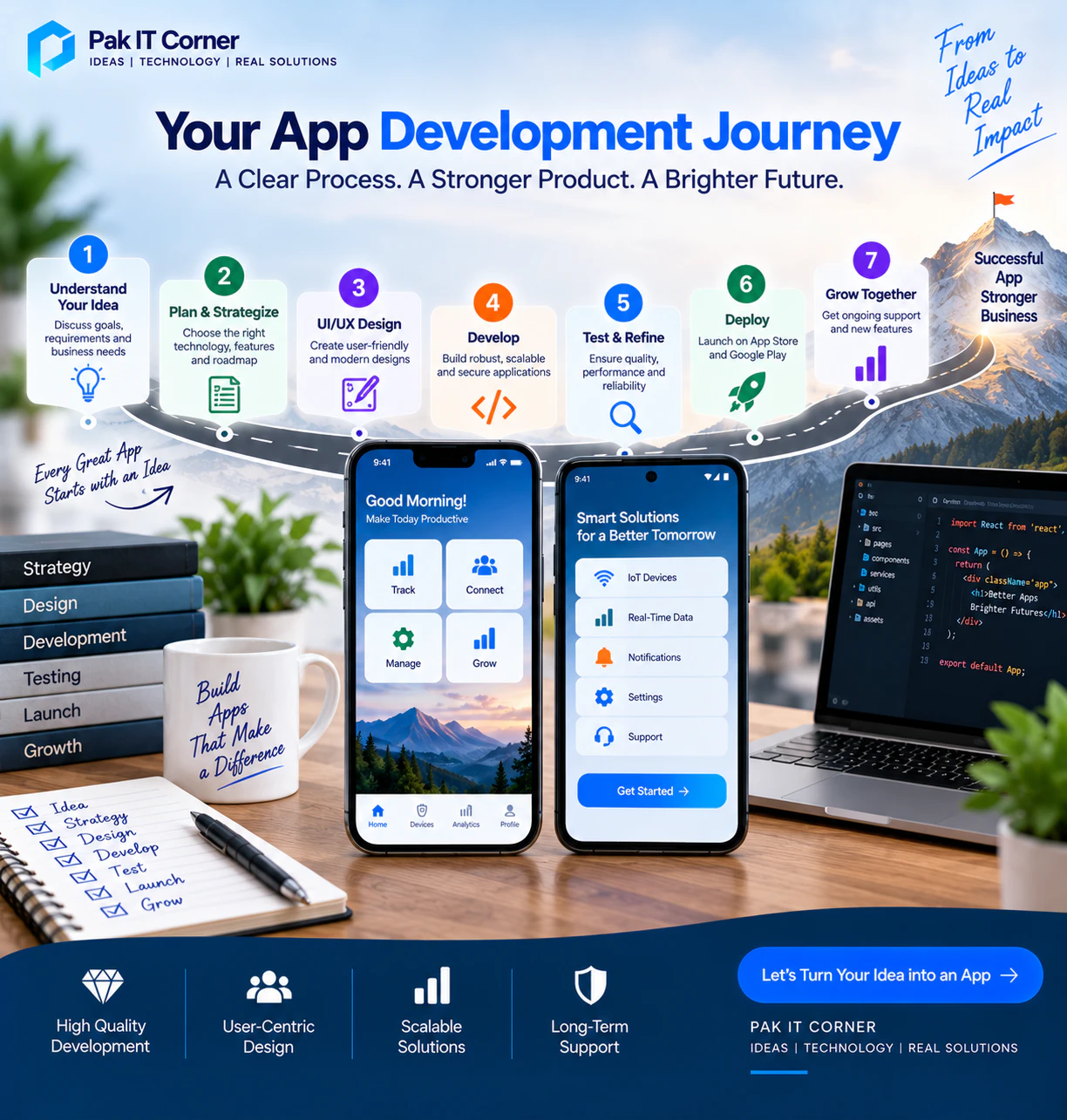
Why Work With Pak IT Corner?
Pak IT Corner provides comprehensive development services across mobile applications, web applications, IoT systems, and connected hardware.
Our capabilities include:
- Native iOS app development (Swift, SwiftUI)
- Native Android app development (Kotlin, Jetpack Compose)
- Flutter cross-platform app development (iOS & Android)
- Web application and admin dashboard development
- Backend APIs, microservices, and database architecture
- Bluetooth Low Energy (BLE) scanning, pairing, and communication
- Wi-Fi provisioning and IoT companion applications
- ESP32 and embedded firmware development
- Cloud-connected device infrastructure (MQTT, REST, WebSockets)
- Custom PCB design and hardware engineering
- App Store and Google Play deployment management
- Ongoing maintenance and technical support
For connected products, having experience across mobile software and embedded hardware simplifies development because communication between the device, firmware, mobile app, and cloud is engineered as one unified system — explore our past projects in our portfolio or review our flexible packages.
Frequently Asked Questions
How do I choose the best mobile app development company?
Evaluate technical expertise, portfolio, communication, development process, testing, security, source-code ownership, deployment experience, and post-launch support. Choose a company whose experience matches the technical requirements of your project.
Should I choose Flutter or native app development?
Flutter can be a strong choice when you need Android and iOS applications with shared development. Native development may be preferable when your application requires deep platform-specific functionality or highly specialized integrations.
How much does mobile app development cost?
The cost depends on application complexity, platforms, UI/UX, backend requirements, integrations, security, testing, and ongoing support. A development company should review your requirements before providing a detailed quotation.
How long does mobile app development take?
Simple applications may require several weeks, while larger applications can require several months. The timeline depends on scope, complexity, platforms, backend requirements, testing, and approval cycles.
Should the client own the source code?
For custom development projects, source-code ownership and delivery conditions should be clearly defined before development begins. Clients should understand exactly what project files and credentials they will receive.
Can one company develop the app, backend, and IoT hardware?
Yes, some engineering teams work across mobile applications, backend systems, embedded firmware, and hardware. This can be particularly useful for IoT products because all parts of the system must communicate reliably.
Should I build Android or iOS first?
The decision should be based on your target users, geographic market, budget, product requirements, and business strategy. Cross-platform development can also allow businesses to target both platforms from the beginning.
What should I prepare before contacting an app development company?
Prepare your product idea, target audience, core features, preferred platforms, approximate budget, expected timeline, reference applications, and any existing designs or technical documentation.
Final Thoughts
Choosing a mobile app development company should not be based on price alone.
Look for a team that understands your users, business goals, technical requirements, security needs, and long-term product roadmap.
Review its real experience, understand its development process, clarify ownership and deliverables, and make sure communication expectations are established before development begins.
The right development partner should help you move from an idea to a reliable product while making technical decisions that support future growth.
If you are planning an Android, iOS, Flutter, web, or IoT application, Pak IT Corner can help you evaluate the technical requirements and develop a solution designed around your product goals.