
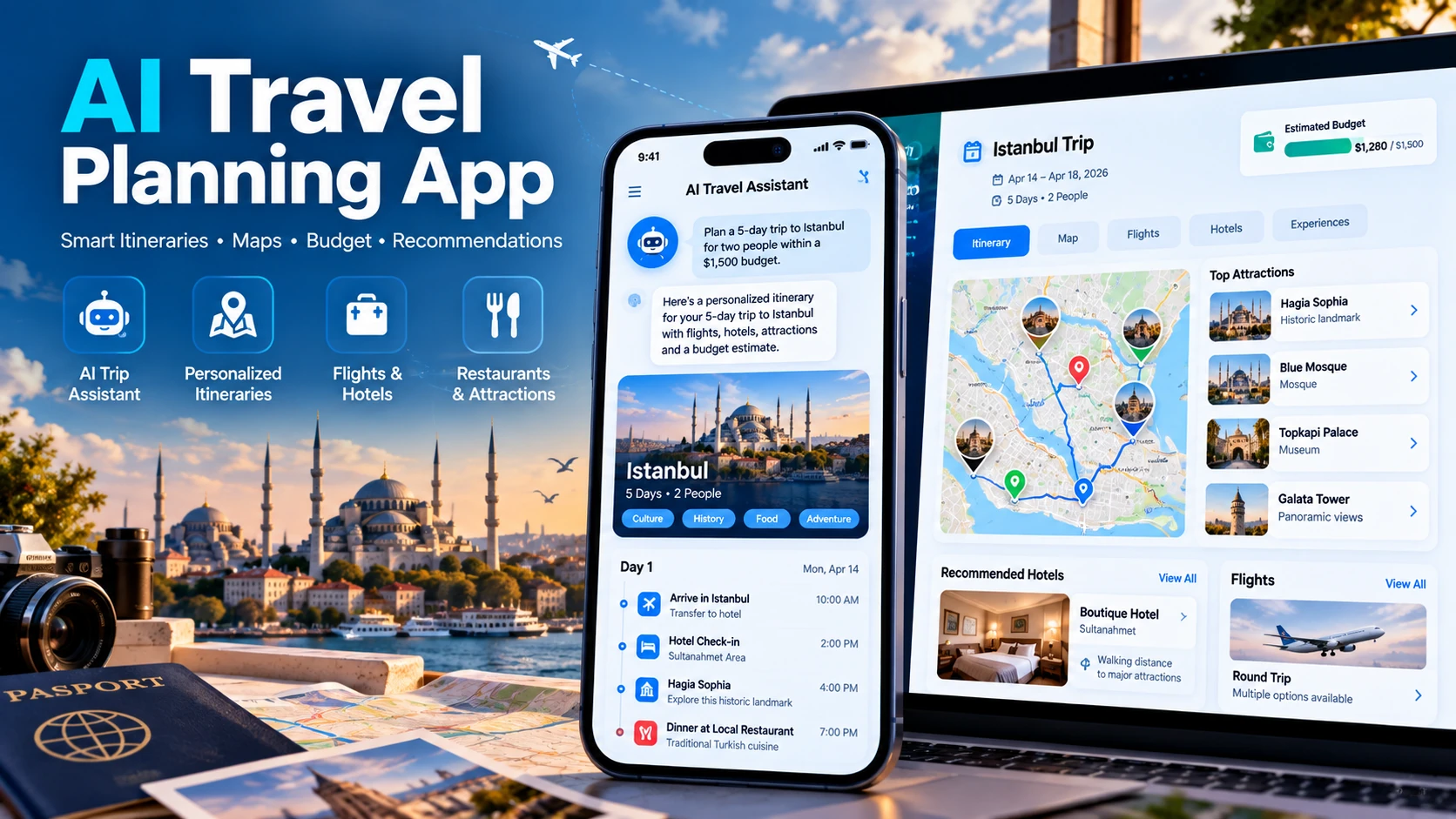
Traditional travel planning is notoriously fragmented. Travelers spend hours bouncing between flight comparison search engines, hotel booking aggregators, blog articles, map bookmarks, and static spreadsheets. When travel details shift — due to flight delays, weather closures, or budget constraints — the entire plan must be reworked manually.
Modern artificial intelligence offers an architectural solution to this friction. An AI-powered travel planning app acts as an intelligent co-pilot: understanding complex user constraints, synthesizing real-world geospatial data, and dynamically assembling personalized, bookable day-by-day itineraries in seconds.
Building a successful AI travel platform requires far more than wrapping a generic conversational prompt around an LLM. It demands robust systems architecture: deterministic schema validation, resilient integration with third-party travel APIs, efficient offline caching for mobile travelers, and an intuitive user interface.
This technical guide outlines the end-to-end development process for building an enterprise-grade AI travel planning application, from core feature sets and systems architecture to cost drivers and MVP planning.
Core Features of an AI Travel Planning Application
A production travel application must balance conversational flexibility with structured, executable data. Users need natural language exploration during the brainstorming phase, but precise logistical control when executing their trip.
1. Conversational AI Assistant & Itinerary Generator
At the center of the application is an intelligent trip planner capable of multi-turn dialogue. The assistant processes high-level requirements — such as destination preferences, travel dates, pacing (relaxed vs. fast-paced), dietary restrictions, and mobility constraints — and generates coherent itineraries broken down by morning, afternoon, and evening segments.
2. Budget-Aware Financial Planning
Travelers rarely plan in an economic vacuum. The platform should allocate expenses across flights, lodging, daily dining, local transit, and ticketed activities, continuously tracking estimated costs against user-defined financial ceilings.
3. Maps, Places & Routing Integration
An itinerary is only practical if geographic travel times make sense. Integrating map engines like Google Places, Mapbox, or OpenStreetMap ensures venues are grouped logically by neighborhood, calculating realistic walking and driving transit times between consecutive stops to prevent unrealistic schedules.
4. Live Hotel and Flight Discovery
Integrating global distribution systems (GDS) or flight and hotel aggregators enables the app to display live pricing, availability, and booking links directly alongside the generated itinerary, transitioning the user from discovery to booking without leaving the ecosystem.
5. Collaborative Trip Sharing & Offline Access
Travel is frequently a group activity. Multi-user trip sharing allows companions to view itineraries, vote on activity options, and synchronize modifications in real time. Because travelers often experience intermittent cellular connectivity abroad, robust offline caching is critical for accessing tickets, confirmation numbers, and daily schedules without active data.
System Architecture: How the AI Travel Engine Works
The biggest architectural trap in AI app development is relying entirely on unconstrained language model outputs. Raw LLM responses frequently hallucinate non-existent attractions, invent invalid operating hours, or produce geographically illogical routes. A production architecture enforces a strict separation between the AI reasoning layer and deterministic data verification.
| Layer | Core Responsibility | Recommended Technologies |
|---|---|---|
| Client Applications | User interface, offline storage, state management, interactive map rendering | Flutter (iOS & Android), React / Next.js (Web Dashboard) |
| API Gateway & Auth | Request routing, rate limiting, token validation, user profile management | FastAPI, Node.js / Express, Supabase Auth, Firebase Auth, OAuth2 |
| AI Orchestrator | Prompt chaining, function calling, schema enforcement, latency streaming | LangChain, LlamaIndex, OpenAI GPT-4o / Claude 3.5 Sonnet / Gemini 1.5 Pro |
| External Data Services | Live flight/hotel pricing, venue details, geocoding, route calculation | Amadeus API, Skyscanner API, Google Places, Mapbox SDK |
| Primary & Vector Data | User trips, relational metadata, destination embeddings for semantic search | PostgreSQL with pgvector, Redis Cache, Amazon S3 / Cloudflare R2 |
The End-to-End Architectural Data Flow
Consider the architectural lifecycle of an itinerary generation request:
- Client Request: The traveler submits a trip prompt on mobile or web (e.g., "Plan a 5-day trip to Istanbul for two people within a $1,500 budget focused on historic architecture and culinary walks").
- Parameter Extraction: The backend API Gateway routes the input to the AI Orchestrator. An LLM parser extracts structured parameters: destination (Istanbul, IST), duration (5 days), party size (2 adults), budget ceiling ($1,500 USD), and thematic tags (historic, culinary).
- Grounding via External APIs: Rather than allowing the LLM to invent hotel prices or museum schedules, the orchestrator triggers tool calls to verified third-party services:
- Queries travel APIs (e.g., Amadeus) for actual hotel options matching the budget bracket.
- Queries Google Places / Mapbox for historic landmarks and highly rated culinary spots in specific districts (Sultanahmet, Beyoğlu, Kadıköy).
- Itinerary Synthesis & Schema Validation: The retrieved, factual venue payloads are fed back into the LLM with strict JSON schema instructions (via Pydantic or TypeScript Zod). The model groups venues by geographic proximity and builds a day-by-day itinerary.
- Deterministic Route Validation: A routing algorithm verifies transit times between stops. If two attractions are too far apart for an afternoon window, the backend adjusts the schedule before delivery.
- Caching and Client Delivery: The validated itinerary is stored in PostgreSQL, cached in Redis, and streamed down to the client app where it renders as an interactive card deck and route map.
Note: The Istanbul trip example described above is an illustrative product-development scenario demonstrating how modern multi-API travel orchestration works in practice, rather than an operational commercial service.
Mobile Application Architecture: Flutter vs. Native
Choosing the right mobile development approach determines your launch velocity, engineering budget, and long-term maintenance overhead. For most travel applications, a cross-platform framework like Flutter provides significant commercial advantages.
Flutter allows engineering teams to ship identical, high-performance client applications across both iOS and Android from a single Dart codebase. Because travel apps rely heavily on fluid animations, custom card layouts, and complex interactive map overlays, Flutter's dedicated rendering engine ensures 60 FPS performance without platform-specific rendering discrepancies. For detailed architectural tradeoffs between unified codebases and platform-specific builds, explore our in-depth analysis on Flutter vs. Native App Development.
Native development (Swift/SwiftUI for iOS and Kotlin/Jetpack Compose for Android) remains a strong alternative if the application heavily prioritizes deep system integrations — such as lock-screen Live Activities for active flight gates, native Apple Wallet boarding pass management, or custom offline GPS tracking algorithms. Teams debating platform launch timing can reference our guide on iOS vs. Android: Which Should You Build First?.
Development Roadmap: From MVP to Enterprise Scale
Launching an ambitious AI product requires disciplined phased delivery. Attempting to build full global booking engine integrations on day one often leads to scope creep and excessive licensing expenses.
| Phase | Core Scope | Target Outcome |
|---|---|---|
| Phase 1: Discovery & Prompt Engineering (Weeks 1–3) | Define user personas, design system, API evaluation, prompt latency benchmarks | Functional interactive Figma prototypes and validated LLM orchestration schemas |
| Phase 2: MVP Core Platform (Weeks 4–9) | User authentication, AI itinerary engine, Mapbox map view, trip saving, basic PDF/share export | Testable beta application on TestFlight and Google Play Internal Testing |
| Phase 3: Live API Integrations (Weeks 10–14) | Flight and hotel aggregator API integration, affiliate booking links, weather feeds | End-to-end commercial platform with real-world booking referral capability |
| Phase 4: Collaboration & Optimization (Weeks 15–18+) | Multi-user trip editing, push notifications, offline vector storage, telemetry analytics | Production public launch on App Store and Google Play |
Cost Factors in AI Travel App Development
Understanding cost drivers early prevents budget shortfalls during engineering. Travel application development costs vary across four primary categories:
- Mobile & Web Frontend Engineering: The complexity of custom UI, map interaction layers, offline synchronization engines, and multi-platform support (web dashboards alongside mobile apps).
- Backend & Database Architecture: Building scalable REST/GraphQL endpoints, multi-tenant databases, caching layers, and security infrastructure to handle concurrent user sessions. For a detailed breakdown of software investment tiers, review our comprehensive analysis on Mobile App Development Costs in 2026.
- Third-Party Travel API Licensing: While mapping platforms like Mapbox and Google Maps offer generous free developer tiers, enterprise flight and hotel data aggregators (Amadeus, Sabre) often require commercial agreements or transaction-based fees once transaction volumes scale.
- LLM Token Consumption: Incurred during itinerary generation and conversational chat sessions. Efficient system prompt caching and choosing fast, cost-effective models (such as GPT-4o-mini or Claude 3.5 Haiku) for intermediate parsing tasks significantly reduce operational server overhead.
Frequently Asked Questions
How does an AI travel planning app generate personalized itineraries?
The app combines large language models (LLMs) with external travel APIs. The user inputs destination, dates, budget, and travel style. An orchestration backend converts this request into structured prompts, retrieves live availability from flight, hotel, and places APIs, and uses function calling to construct a coherent, geocoded day-by-day itinerary.
Which external APIs are required for an AI travel planner?
Core integrations typically include flight and hotel booking aggregators (such as Amadeus, Skyscanner, or Sabre), location and mapping platforms (Google Places, Mapbox), weather forecasts (OpenWeather), and LLM provider APIs (OpenAI, Anthropic Claude, or Google Gemini) for natural-language orchestration.
Should a travel planning app be built with Flutter or native mobile code?
Cross-platform frameworks like Flutter allow you to launch simultaneously on iOS and Android from a unified codebase, reducing initial development time and engineering costs. Native development in Swift and Kotlin is preferable if you require advanced platform-specific AR navigation or complex background geolocation tracking.
How do you handle LLM hallucinations in trip itineraries?
Hallucinations are mitigated through Retrieval-Augmented Generation (RAG) and strict schema validation. Rather than letting the LLM invent venues, the backend queries verified place databases (such as Google Places API) for actual coordinates and operating hours, injecting verified records into the model prompt and enforcing structured JSON responses via Pydantic or Zod.
What is the typical timeline to launch an AI travel planner MVP?
A focused minimum viable product (MVP) featuring core itinerary generation, user authentication, interactive map visualization, and basic trip saving typically takes between 10 to 16 weeks of engineering effort.
Plan Your Next AI-Powered Application with Pak IT Corner
Transforming complex AI workflows into smooth, reliable consumer and enterprise mobile applications requires end-to-end engineering expertise. At Pak IT Corner, we help startups and established brands conceptualize, design, and engineer scalable iOS, Android, and web applications backed by modern AI integration.
Whether you're developing an MVP or scaling an enterprise platform, explore our past work in our portfolio or review our structured development packages.