
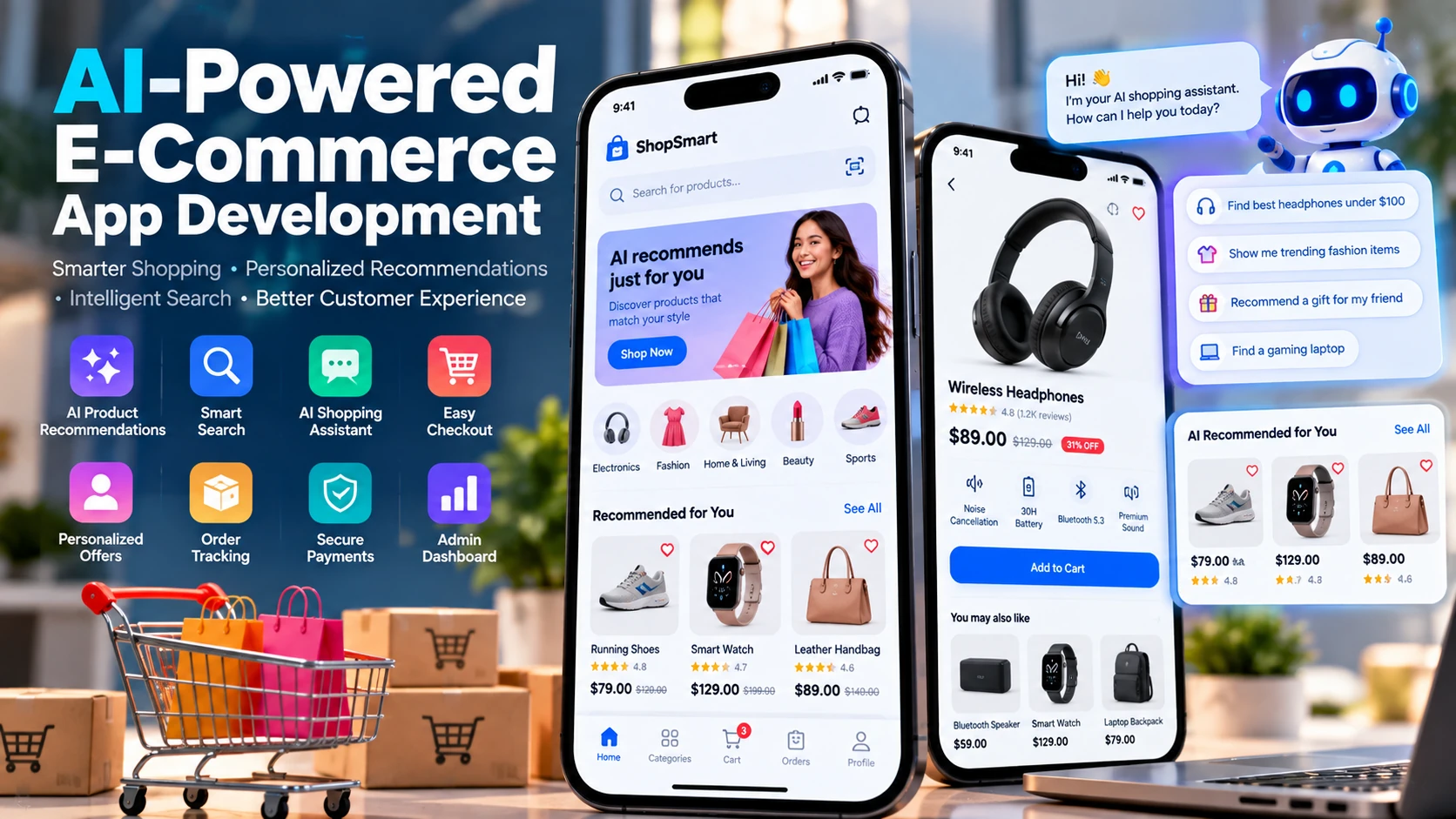
Mobile shopping has undergone a profound shift. Consumers no longer browse through deep, static category trees or struggle with rigid search bars that return zero results when a query contains a typo or natural phrasing. Today's mobile shoppers expect intuitive discovery, instant answers, and tailored catalogs that reflect their individual preferences.
Artificial intelligence is redefining e-commerce architecture from the ground up. By embedding machine learning models, vector embeddings, and large language model (LLM) agents into modern mobile applications, online retailers can replace static storefronts with dynamic, personalized shopping experiences.
However, successful e-commerce engineering requires a rock-solid retail foundation before layering on intelligent automation. An application with cutting-edge recommendation algorithms will still fail if its cart checkout is clunky, payment webhooks are unreliable, or inventory synchronizations lag behind orders.
In this guide, we break down the complete architecture of AI-powered e-commerce applications, detailing both core transactional systems and the intelligent layers that elevate product discovery, customer support, and user retention.
The Two Layers of Modern E-Commerce Applications
High-performing retail apps are built in two complementary tiers: the Transactional Commerce Engine, which guarantees operational reliability, and the Intelligent Shopping Layer, which eliminates browsing friction.
| Functional Tier | Core Components | Architectural Focus |
|---|---|---|
| 1. Transactional Commerce Core | Product catalog, variant selection, cart, checkout, payment processing, order tracking, user accounts, push notifications, admin CMS | ACID database transactions, high concurrency, PCI-DSS compliance, zero-downtime inventory locks |
| 2. Intelligent Shopping Layer | Semantic natural-language search, vector-based recommendations, AI shopping assistant, automated review summaries, dynamic bundles | Vector databases (pgvector / Qdrant), LLM prompt orchestration, asynchronous embedding workers, semantic caching |
Core Features of the Transactional Foundation
Every commercial application must execute fundamental retail workflows with uncompromising reliability:
1. High-Performance Product Catalog & Variants
The catalog must support complex multi-attribute hierarchies: sizing, color swatches, stock availability per SKU, high-resolution imagery, and nested categories. Fast client-side caching ensures category browsing feels instantaneous even on slower mobile networks.
2. Resilient Cart & Multi-Gateway Checkout
Cart state must synchronize seamlessly between guest sessions and authenticated user accounts across devices. Checkout flows should integrate trusted mobile payment methods — Apple Pay, Google Pay, and Stripe Elements — minimizing form friction and abandoned carts.
3. Real-Time Inventory & Order Management
When high-demand items drop, database race conditions can lead to overselling. Implementing distributed locking mechanisms (via Redis or database row locks) ensures inventory decrementing occurs atomically during order creation.
4. Automated Notifications & Tracking
Triggered push notifications keep customers informed at key transactional milestones: order confirmation, warehouse dispatch, out-for-delivery status, and automated review requests.
The AI-Powered Shopping Features That Drive Value
Once the transactional backbone is secure, artificial intelligence transforms how shoppers locate, evaluate, and purchase products:
1. Semantic & Natural-Language Product Search
Traditional SQL `LIKE` queries or simple lexical search engines fail when users search conceptually — for example, typing "breathable running shoes for marathon training in hot weather". By generating vector embeddings for product titles, descriptions, and customer reviews, vector search engines match the semantic meaning of the shopper's intent against your catalog, surfacing relevant items even when product titles don't share exact keywords.
2. Personalized Recommendation Engines
Rather than displaying generic "bestsellers" to every user, machine learning recommendation systems blend collaborative filtering (what similar shoppers viewed and purchased) with real-time in-session clickstream data. If a customer is inspecting minimalist work desks, the recommendation pipeline dynamically surfaces compatible ergonomic chairs and desk lamps.
3. Conversational AI Shopping Assistants
Embedded in-app assistants act as digital sales associates. Using retrieval-augmented generation (RAG), the assistant accesses real-time catalog databases and answered customer queries to provide informed recommendations: "Which of these jackets is warmer for sub-zero temperatures?" or "Suggest an outfit matching these brown leather boots under $150."
4. Automated Customer Review Summarization
Modern shoppers rarely have time to read hundreds of user reviews. Background AI workers ingest customer feedback, identify common patterns, and generate concise sentiment summaries: highlighting validated pros (e.g., "True to size, excellent arch support") and cons (e.g., "Slightly narrow toe box"), accelerating buyer decision-making.
5. 24/7 Intelligent Customer Support Triage
AI support bots resolve high-frequency tier-1 inquiries — including order status lookups, return policy questions, and shipping timeframe estimates — through secure backend API integration, escalating complex disputes to human agents with full conversation context.
System Architecture & Data Pipeline
Integrating machine learning into an e-commerce platform requires careful pipeline design to ensure AI processing never introduces latency into transactional checkout paths.
Architectural Overview
- Mobile Frontend: Built using cross-platform frameworks such as Flutter for simultaneous iOS and Android deployment, communicating with the backend over secure REST and GraphQL endpoints. Read more about cross-platform advantages in our comparison of Flutter vs. Native App Development.
- API Gateway & Application Server: Node.js, Go, or Python (FastAPI) handling request routing, rate limiting, and JWT authentication.
- Relational Database: PostgreSQL managing orders, user profiles, inventory SKUs, and payment ledgers with strict ACID guarantees.
- Vector Database / Semantic Search: PostgreSQL with `pgvector` or dedicated vector stores (Qdrant, Pinecone) indexing product embeddings generated by models such as `text-embedding-3-small`.
- Asynchronous Message Queue: Redis BullMQ, RabbitMQ, or Amazon SQS offloading compute-heavy tasks — such as generating catalog embeddings, processing review summaries, and dispatching marketing emails — away from user-facing threads.
- Payment Gateway: Direct client-side SDK integration with Stripe or Adyen, maintaining complete isolation from LLM pipelines to satisfy PCI-DSS compliance standards.
Security, Privacy & Scalability Considerations
Retail applications handle sensitive customer information, financial credentials, and personal address data. Security must be an architectural priority from day one:
- Payment Tokenization: Raw card details must never touch your application database or be passed to any AI model context. All payment processing must rely strictly on tokenized payment methods handled by certified PCI-DSS compliant providers.
- Role-Based Access Control (RBAC): Administrative backends should enforce granular permissions, restricting customer service representatives from viewing full financial records while allowing fulfillment staff to process shipping labels.
- Flash Sale Scalability: Peak traffic surges (e.g., Black Friday or limited-edition drops) demand multi-layer caching. Product detail pages should be cached at edge CDN locations, reducing database query pressure by up to 90%.
- Data Sanitization for LLMs: When routing customer service requests to conversational AI models, personal identifiable information (PII) — such as credit card numbers, phone numbers, and physical addresses — must be scrubbed using regex masking before prompt transmission.
Development Roadmap: MVP vs. Advanced Product
A structured, phased release strategy mitigates risk and ensures core commerce operations are battle-tested before advanced AI features are deployed.
| Milestone | Key Deliverables | Estimated Timeline |
|---|---|---|
| Phase 1: Architecture & UI/UX | Figma design system, database schemas, inventory data modeling, API contracts | Weeks 1–3 |
| Phase 2: Core Commerce Engine | Catalog management, cart logic, Stripe checkout, order placement, basic push alerts | Weeks 4–8 |
| Phase 3: Search & AI Integration | Semantic vector search, basic recommendation widgets, automated review summarization | Weeks 9–13 |
| Phase 4: Optimization & Launch | Conversational shopping bot, admin analytics dashboard, load testing, App Store submission | Weeks 14–16+ |
Cost Factors in E-Commerce App Development
The total investment for custom e-commerce software depends on multiple structural factors:
- Platform Support: Launching a cross-platform Flutter application covering both iOS and Android simultaneously is generally more cost-efficient than building separate native codebases from scratch. Review our analysis on Mobile App Development Costs in 2026.
- Third-Party Integrations: Enterprise ERP synchronizations (SAP, NetSuite), external warehouse logistics APIs, and specialized tax calculation engines (Avalara) introduce custom integration requirements.
- Vector Search & AI Hosting: Hosting dedicated vector databases and consuming LLM API tokens introduce recurring cloud operational costs that scale with active catalog searches.
- Admin Backoffice Complexity: Custom backoffices managing multi-vendor marketplaces require significantly more engineering effort than standalone single-brand stores. Teams considering multi-platform reach can also explore whether a Web App vs. Mobile App is best suited for their initial launch.
Frequently Asked Questions
How does semantic search differ from keyword search in an e-commerce app?
Traditional keyword search matches exact text tokens or fuzzy variations. Semantic search converts queries and product catalogs into dense mathematical vector embeddings, allowing the app to understand user intent and conceptual context (such as searching for "warm jacket for rainy commutes" and returning waterproof insulated parkas even if those exact words are absent).
What is the best mobile framework for building an AI-powered shopping app?
Flutter is highly recommended for e-commerce because it enables rapid, simultaneous delivery across iOS and Android with a shared UI engine, unified state management, and high-performance scrolling catalogs. Native Swift and Kotlin remain preferred if extensive platform-specific hardware features or AR object placement require native ARKit and ARCore pipelines.
How can e-commerce applications protect user payment data while using AI?
Payment processing must remain completely decoupled from AI and LLM inference pipelines. Applications must use PCI-DSS Level 1 compliant payment gateways (such as Stripe or Adyen) with client-side tokenization, ensuring raw credit card numbers never touch your application server or AI context windows.
How does AI summarize customer product reviews effectively?
The backend runs asynchronous background workers that ingest verified reviews, cluster customer feedback into semantic themes (e.g., sizing, durability, material feel), and use large language models with strict schema constraints to generate concise pros-and-cons summaries with citation counts.
How long does it take to develop an AI-powered e-commerce application?
A standard e-commerce mobile MVP with catalog browsing, shopping cart, payment integration, and foundational AI recommendations typically takes 12 to 16 weeks of engineering effort.
Build Your Custom E-Commerce Solution with Pak IT Corner
At Pak IT Corner, we engineer robust, scalable mobile commerce platforms tailored to modern consumer expectations. From high-converting iOS and Android shopping applications to complete web dashboards and AI-driven recommendation backends, our team delivers production-ready retail software.
Ready to engineer an intelligent shopping experience? Review our past software projects in our portfolio, examine our transparent development packages, or speak directly with our engineering team.