
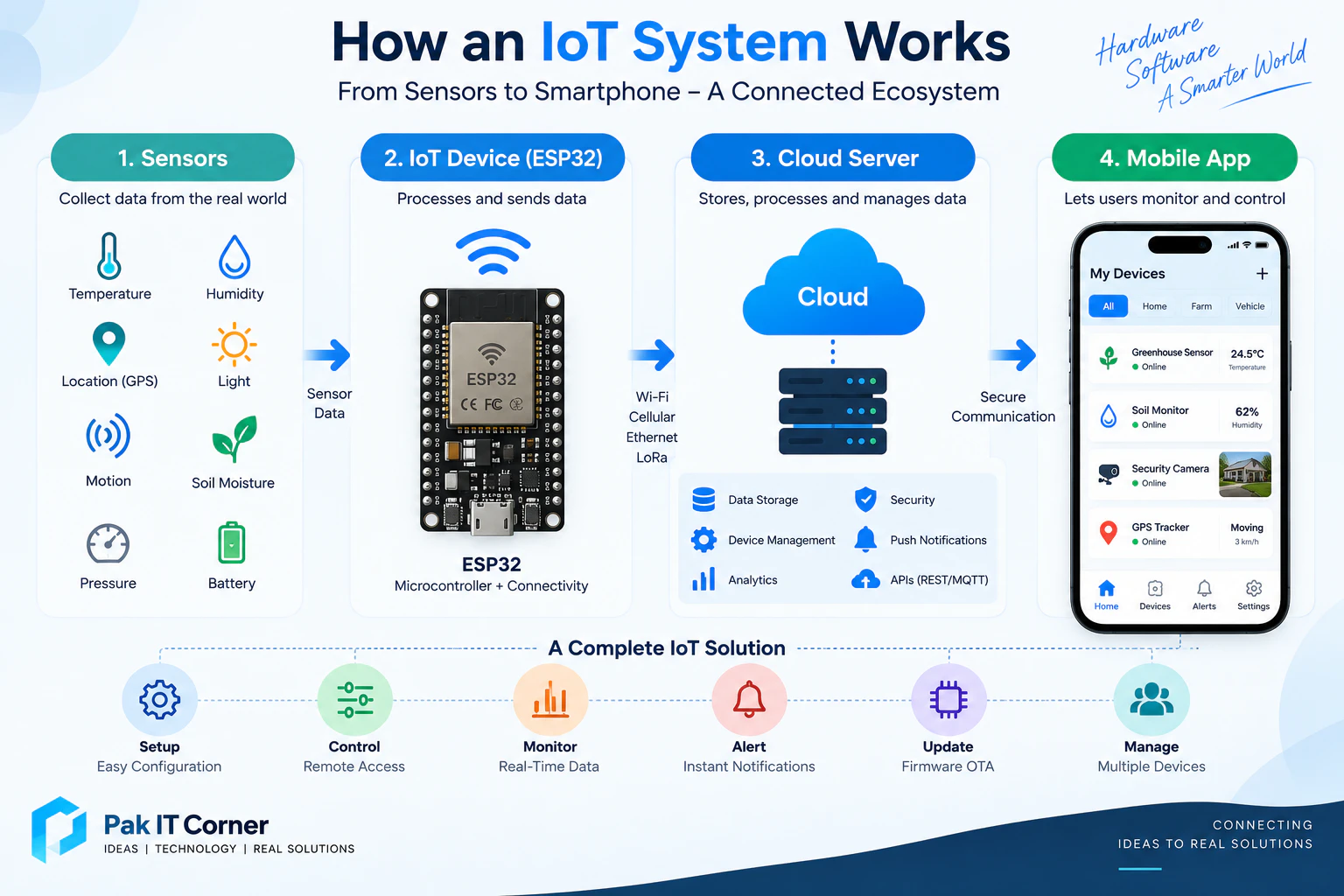
Developing an Internet of Things (IoT) product is fundamentally different from building a pure software mobile app or a standalone electronic circuit. An IoT ecosystem requires four separate engineering disciplines working in complete synchronization: physical hardware, embedded firmware, cloud infrastructure, and user-facing mobile or web applications.
When founders ask, “How much does IoT product development cost?”, they frequently receive confusing answers because software development agencies only estimate the mobile app, while hardware design firms only quote the schematic and bare PCB layout.
In this guide, we break down the total cost of developing a connected IoT product in 2026 across every layer of the technology stack, showing where budgets are allocated and how to eliminate expensive coordination bottlenecks.
Total IoT Product Development Budget Tiers (2026)
The total investment needed depends on device complexity, radio protocols (BLE, Wi-Fi, Cellular, LoRaWAN), power requirements (battery vs. mains), and regulatory standards. The table below provides realistic, real-world development ranges:
| Project Tier | Estimated Total Budget | Typical Timeline | Key Deliverables |
|---|---|---|---|
| Tier 1: Proof of Concept / MVP Smart sensor, BLE beacon, or basic Wi-Fi device |
$12,000 – $28,000 | 2 – 3 months | Custom 2–4 layer PCB, working firmware, basic cloud telemetry/REST API, and MVP mobile app for device configuration. |
| Tier 2: Commercial Connected Product Smart home appliance, commercial tracker, agricultural monitor |
$28,000 – $65,000 | 3 – 6 months | Production-ready 4-layer PCB, robust FreeRTOS firmware with secure OTA updates, MQTT cloud backend, polished iOS & Android companion apps, 3D enclosure CAD. |
| Tier 3: Enterprise / Industrial IoT Industrial monitoring, smart energy, healthcare/medical device |
$65,000 – $130,000+ | 6 – 12 months | Ruggedized multi-board architecture, cellular/LTE-M connectivity, high-security crypto provisioning, fault-tolerant cloud platform, multi-role web portal, pre-compliance testing. |
Cost Breakdown by Engineering Discipline
To plan your budget accurately, it is essential to inspect each layer of the IoT architecture individually:
1. Hardware & PCB Design
Cost Range: $3,500 – $12,000
Includes electrical architecture, component sourcing, schematic capture in KiCad/Altium, high-density multilayer routing, DFM reviews, and fabrication of 5–10 assembled PCBA prototype units. Read our detailed custom PCB design cost breakdown for in-depth figures.
2. Embedded Firmware
Cost Range: $4,500 – $18,000
Writing drivers for sensors and power management ICs, state machine architecture, FreeRTOS task scheduling, BLE/Wi-Fi wireless communication stacks, low-power sleep state tuning, cryptographic device authentication, and Over-The-Air (OTA) update mechanisms.
3. Cloud Backend & Data Pipeline
Cost Range: $3,000 – $14,000
MQTT message brokers (AWS IoT Core, EMQX, or Mosquitto), device registry, time-series data storage, REST/GraphQL APIs, alerting microservices, and user authorization management.
4. Companion Mobile & Web Apps
Cost Range: $4,000 – $20,000
Native iOS & Android or Flutter companion applications that pair via Bluetooth Low Energy (BLE) or Wi-Fi SoftAP, display real-time sensor charts, manage device configurations, and execute remote firmware updates. Web portals for fleet management and analytics.
Deep Dive: The 4 Engineering Layers of an IoT Product
Layer 1: Electronics & Hardware Engineering
Hardware represents the physical foundation of your device. In 2026, component selection directly dictates long-term unit economics and development velocity. Selecting a proven system-on-chip like the Espressif ESP32-S3 or Nordic nRF52840 allows engineers to leverage pre-certified wireless stacks, saving tens of thousands of dollars in initial RF testing.
Key hardware cost items include:
- Schematic & BOM Engineering: Selecting low-quiescent-current voltage regulators, ESD protection diodes, and high-accuracy sensors with verified global supply chain inventory.
- PCB Routing & Signal Integrity: Optimizing RF ground clearance, trace impedance matching, and decoupling capacitors to eliminate noise. Explore our dedicated PCB design services for professional engineering assistance.
- Prototyping & Assembly (PCBA): Fabricating quick-turn prototype boards, SMT machine stencils, and pick-and-place assembly for testing units.
Layer 2: Embedded Firmware Development
Hardware without firmware is inert silicon. Firmware is often the most underestimated budget item in IoT development because edge devices must operate autonomously for months or years without crashing or corrupting memory.
A production-ready firmware codebase requires:
- Power State Management: Putting the microcontroller into microampere deep-sleep modes between sensor readings to deliver multi-year battery operation.
- Wireless Connectivity Stacks: Implementing robust reconnect algorithms, exponential backoff, and packet checksum validation. For connectivity architectural choices, see our analysis on BLE vs. Wi-Fi for IoT apps.
- Secure Over-The-Air (OTA) Updates: Dual-partition flash memory architectures allowing rollbacks if an update fails, preventing devices from ever being “bricked” in the field.
Layer 3: Cloud Infrastructure & Fleet Management
Once your device sends data, it needs a scalable cloud destination. An IoT cloud architecture handles high-frequency bidirectional traffic:
- Protocol Ingestion: Lightweight MQTT or HTTP protocols processing sensor telemetry with sub-second latency.
- Time-Series Storage: Databases optimized for time-stamped metrics (InfluxDB, TimescaleDB, AWS DynamoDB).
- Device Shadow & Remote Commands: Maintaining device states in the cloud so users can send control commands even when the physical device is temporarily asleep.
If you require scalable web dashboards to visualize fleet telemetry, explore our custom web application development services.
Layer 4: Companion Mobile Apps (iOS & Android)
For end consumers and field technicians, the companion mobile application is the product. Most modern IoT devices rely on a companion smartphone app for setup, pairing, local calibration, and day-to-day interactions.
Critical app functionalities include:
- Seamless BLE Device Discovery & Pairing: Scanning Bluetooth advertisements, MTU negotiation, and pairing without user friction. Read our guide on why modern IoT devices require companion mobile apps.
- Wi-Fi Provisioning: Allowing users to securely transmit their local Wi-Fi SSID and credentials to the IoT device over Bluetooth.
- Real-Time Data Visualization: Live sensor graphs, historical analytics, push notifications, and firmware update triggers.
- Learn more about our cross-platform and native solutions through our dedicated iOS app development and Android app development teams.
Why "Siloed" Development Inflates IoT Costs
The single greatest cause of budget overruns in IoT projects is hiring three disconnected vendors: a hardware bureau in one city, an offshore firmware freelancer, and an app agency in another country.
When the app cannot connect to the board via Bluetooth, the hardware team blames the mobile app's Bluetooth stack, the app team blames the firmware engineer's GATT service table, and the firmware engineer blames the PCB antenna matching. The client pays for dozens of hours of finger-pointing.
By partnering with an integrated engineering team like Pak IT Corner — where hardware designers, embedded engineers, and mobile app developers sit under the same roof — pin assignments, Bluetooth UUIDs, data packets, and power budgets are coordinated concurrently, eliminating weeks of friction.
Proven Strategies to Cut IoT Development Costs
Startups and lean engineering teams can significantly reduce upfront capital expenditure:
- Prototype on Off-The-Shelf Dev Kits First: Validate firmware algorithms on breadboards and development modules before laying out custom PCB copper. Follow our roadmap on ESP32 IoT product development from prototype to production.
- Use Pre-Certified Wireless Modules: Choosing FCC/CE pre-certified modules like the ESP32-WROOM or Nordic nRF modules eliminates up to $30,000 in intentional-radiator compliance lab fees.
- Leverage Cross-Platform App Frameworks: Building companion apps with Flutter provides unified iOS and Android codebases from a single development cycle, cutting mobile development costs by 35% to 45%.
- Adopt Serverless Managed IoT Services: Use managed MQTT brokers (such as AWS IoT Core) rather than hosting and maintaining custom cluster infrastructure during early deployment phases.
Bring Your IoT Product to Life with Pak IT Corner
At Pak IT Corner, we specialize in building turnkey IoT products from initial concept to commercial launch. Our integrated engineering team handles custom PCB schematic and layout, robust embedded firmware, scalable cloud platforms, and intuitive iOS and Android companion apps.
Explore our comprehensive IoT app and product development services, review our transparent pricing packages, or view our completed client work in our portfolio.
Ready to Estimate Your IoT Project?
Send us your product vision, functional requirements, or block diagrams for a detailed, transparent engineering cost estimate.
Request an IoT Consultation