
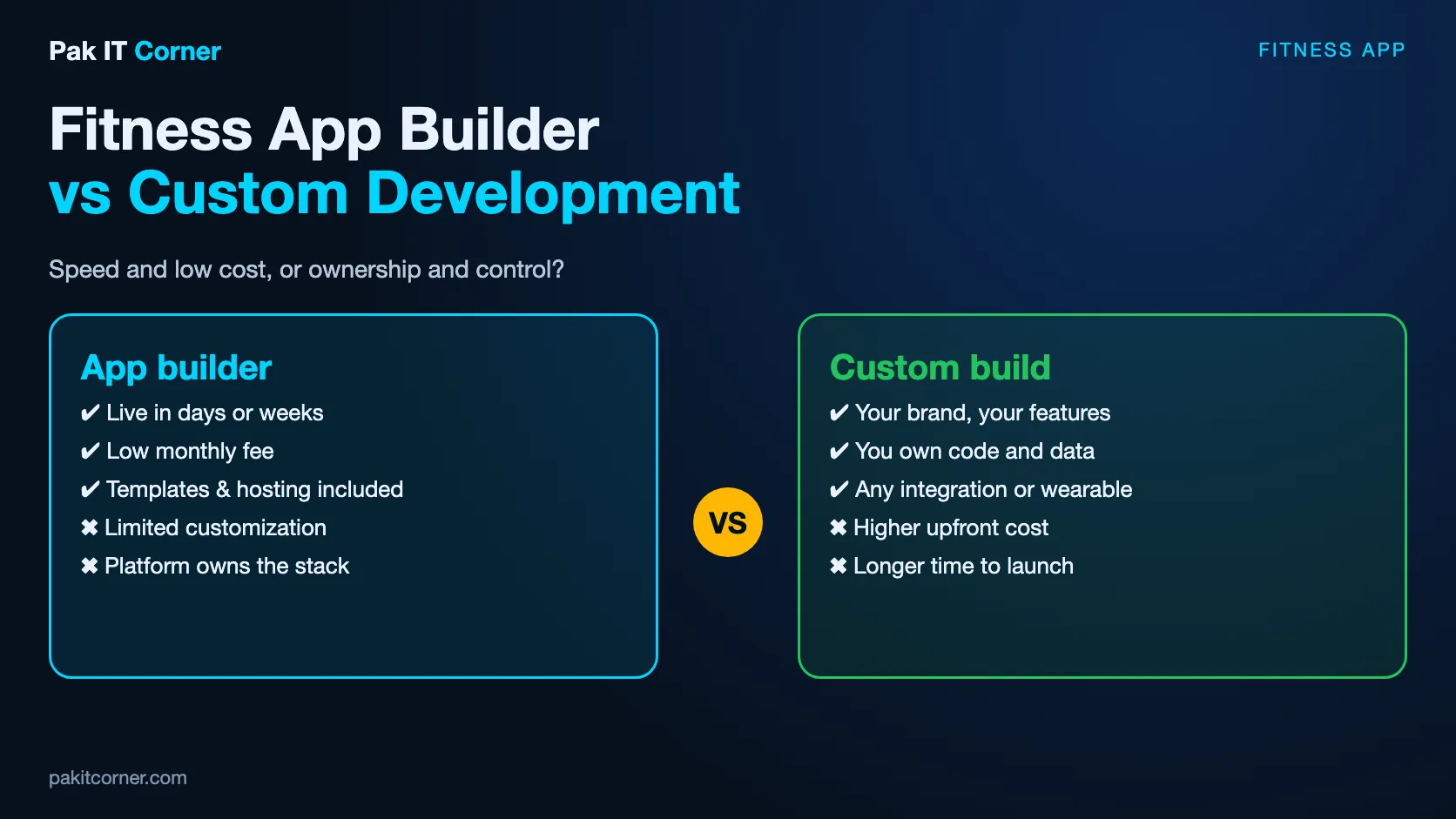
If you want a fitness app, you have two broad options. You can use a fitness app builder (sometimes called a fitness app creator): a template-based or no-code platform where you configure branding, workouts and plans and publish quickly. Or you can commission custom development, where a team designs and builds the app around your exact requirements. Neither is universally better. The right choice depends on your budget, timeline, ambitions and how much control you need.
This guide compares them honestly, including where builders genuinely win, so you can decide before you spend money.
What is a fitness app builder?
A fitness app builder is a platform that provides a ready-made app framework. You typically sign up, choose a template, add your logo, colours, exercises and programmes, connect payments and publish the app under your name. Some are white-label products aimed at personal trainers and gyms, while others are general no-code app makers. You pay a recurring fee, and the platform hosts and maintains the underlying software.
What is custom fitness app development?
Custom development means a team builds the app for you: product design, mobile apps for iOS and Android, a backend, an admin panel and the integrations you need. You own the result, and nothing is limited by a template. It costs more upfront and takes longer, but the app can do exactly what your business needs.
Side-by-side comparison
| Factor | App builder | Custom development |
|---|---|---|
| Time to launch | Days to a few weeks | Typically a few months |
| Upfront cost | Low | Higher |
| Ongoing cost | Recurring subscription, sometimes per user | Hosting, maintenance and updates |
| Design and branding | Template-based, limited changes | Fully unique |
| Features | What the platform offers | Anything you can specify |
| Wearables and integrations | Limited to supported options | Any device or API |
| Code and data ownership | Usually the platform's | Yours |
| Scalability | Bound by platform limits | Designed around your growth |
Cost: subscription versus investment
A builder looks cheap because the monthly fee is small and there is no big upfront bill. Over several years the fees add up, and many platforms raise prices with more users or features. Custom development has a larger initial cost, then lower recurring costs focused on hosting and maintenance, and the app becomes an asset you own. Neither is automatically cheaper over the long run: it depends on how long you will run the app and how much you grow. For a sense of custom budgets, see our mobile app development cost guide.
Speed and validation
If you want to test whether people will pay for your coaching, a builder is hard to beat. You can have a working branded app in front of real clients quickly, learn what they use and only then decide whether to invest further. That makes a builder a sensible way to validate an idea at low risk.
Customization and unique features
This is where builders hit their ceiling. If your plan depends on something the platform does not offer, such as adaptive AI programmes, a custom workout engine, Bluetooth heart-rate straps, a unique community feature or a specialised integration, you will not get it from a template. Custom development removes that limit. If your product idea is the feature set itself, you need custom.
Ownership, data and lock-in
With a builder, your app, your users' data and sometimes your store listing depend on the platform. Before you commit, ask:
- Can I export all my user and workout data in a usable format?
- Is the app published under my own Apple and Google developer accounts, or the vendor's?
- What happens to my app if the vendor raises prices, changes terms or shuts down?
- Do I get access to the source code? (Usually not.)
With custom development, you hold the source code, the data and the developer accounts, which matters if you plan to raise investment, sell the business or move providers.
Store approval and brand quality
App stores expect apps to be distinctive and useful. Apps that are near-identical template clones can run into review issues, and users notice generic experiences. A builder app can still succeed, but it competes on your content and coaching rather than on product quality. A custom app lets the experience itself become part of your brand.
When a fitness app builder is the right choice
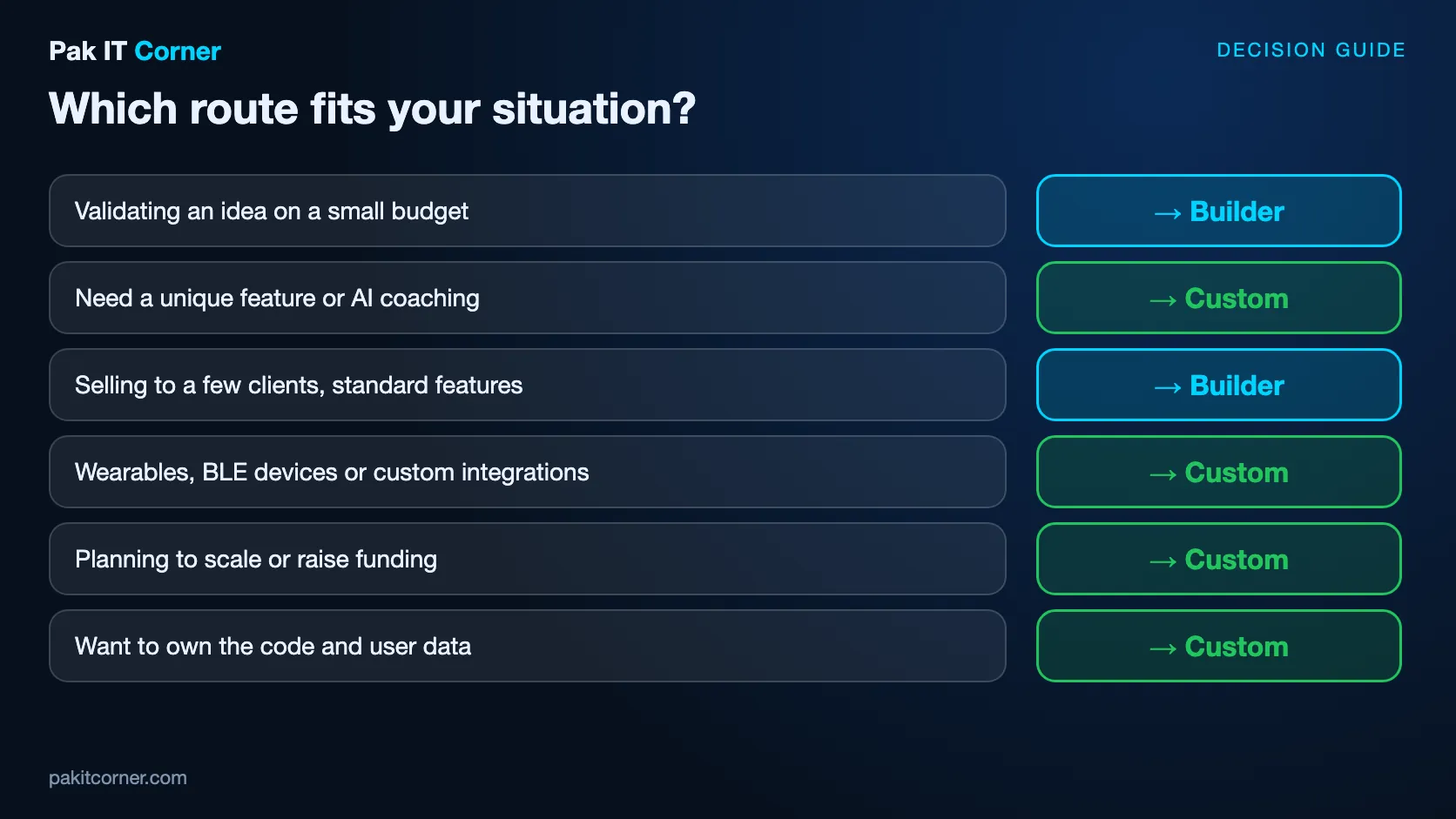
- You are validating an idea with a small budget.
- You are a solo trainer or small studio with standard needs: programmes, check-ins and payments.
- You need to launch quickly and are happy to rely on a platform.
- You do not need custom integrations or unique features yet.
When custom development is the right choice
- Your product has features no template supports, such as AI coaching, wearables or a unique workflow.
- You plan to scale, raise funding or sell the business and need to own the code and data.
- You want a distinctive brand experience.
- You need integrations with your own systems, payments, devices or CRM.
- You want full control over privacy, security and data location.
A middle path: start with a builder, plan to rebuild
Many teams use both. They launch on a builder to validate demand, collect feedback and early revenue, then commission a custom app once they know exactly what to build. To make this work, keep exports of your data, use your own domain and developer accounts where possible, and write down the features users actually asked for. That list becomes the specification for the custom version. Our guide to personal trainer app development shows how to phase those features.
How to decide in five minutes
- List the five features your app absolutely needs.
- Check whether builders you are considering support all five without workarounds.
- If any feature is missing and essential, plan for custom.
- If all five are covered and your goal is speed and low cost, start with a builder.
- Either way, confirm data export and account ownership before you sign.
Frequently asked questions
What is a fitness app builder?
A fitness app builder, or fitness app creator, is a platform that lets you configure a ready-made app with your branding, workouts and plans and publish it without writing code. You usually pay a recurring subscription and the platform hosts and maintains the software.
Is a fitness app builder cheaper than custom development?
It is cheaper to start, because there is little upfront cost. Over several years the subscription fees can add up, while a custom app has higher upfront cost but lower recurring costs and is an asset you own. The better value depends on how long you will run the app and how much you grow.
Can I move from a builder to a custom app later?
Yes, and many teams do. Launch on a builder to validate demand, keep exports of your data, and use what you learn to specify the custom version. Check upfront that you can export your user and workout data.
Do I own the app if I use a fitness app builder?
Usually the platform owns the underlying code and often hosts your data, and your app may be published under their developer account. Ask each vendor about data export, store account ownership and what happens if you leave.
When do I need custom fitness app development?
When you need features a template does not support, such as AI coaching, wearable or Bluetooth device integration, custom integrations or a unique experience, or when you plan to scale, raise funding or need to own the code and data.
Talk to us about your fitness app
At Pak IT Corner we build custom mobile and web apps, including fitness and wellness products. If you are unsure whether you need custom development, tell us what you are building and we will give you a straight answer on scope, timeline and cost, even if the answer is that a builder is enough for now. See our iOS, Android and web development services, or read about building an AI fitness app.